Background
For many years, programming was considered one of the most difficult and valuable skills in the technology industry. Developers often spent years learning programming languages, understanding algorithms, debugging systems, and building software from scratch. Coding required patience, logical thinking, consistency, and continuous learning because technology constantly evolves.
Learning programming is also not easy for everyone. Many beginners struggle with syntax, logic structures, problem-solving, and debugging errors. Different programming languages have different purposes and levels of difficulty.
Some of the most commonly used programming languages today include:
1. HTML & CSS
Usually considered beginner-friendly because they focus on website structure and design.
2. JavaScript
Widely used for interactive websites, front-end development, and modern web applications.
3. Python
Popular for artificial intelligence, automation, machine learning, and data science because of its simple syntax.
4. Java
Commonly used for enterprise systems, Android applications, and backend development.
5. C++ & Rust
Often considered more difficult because they involve system-level programming and performance optimization.
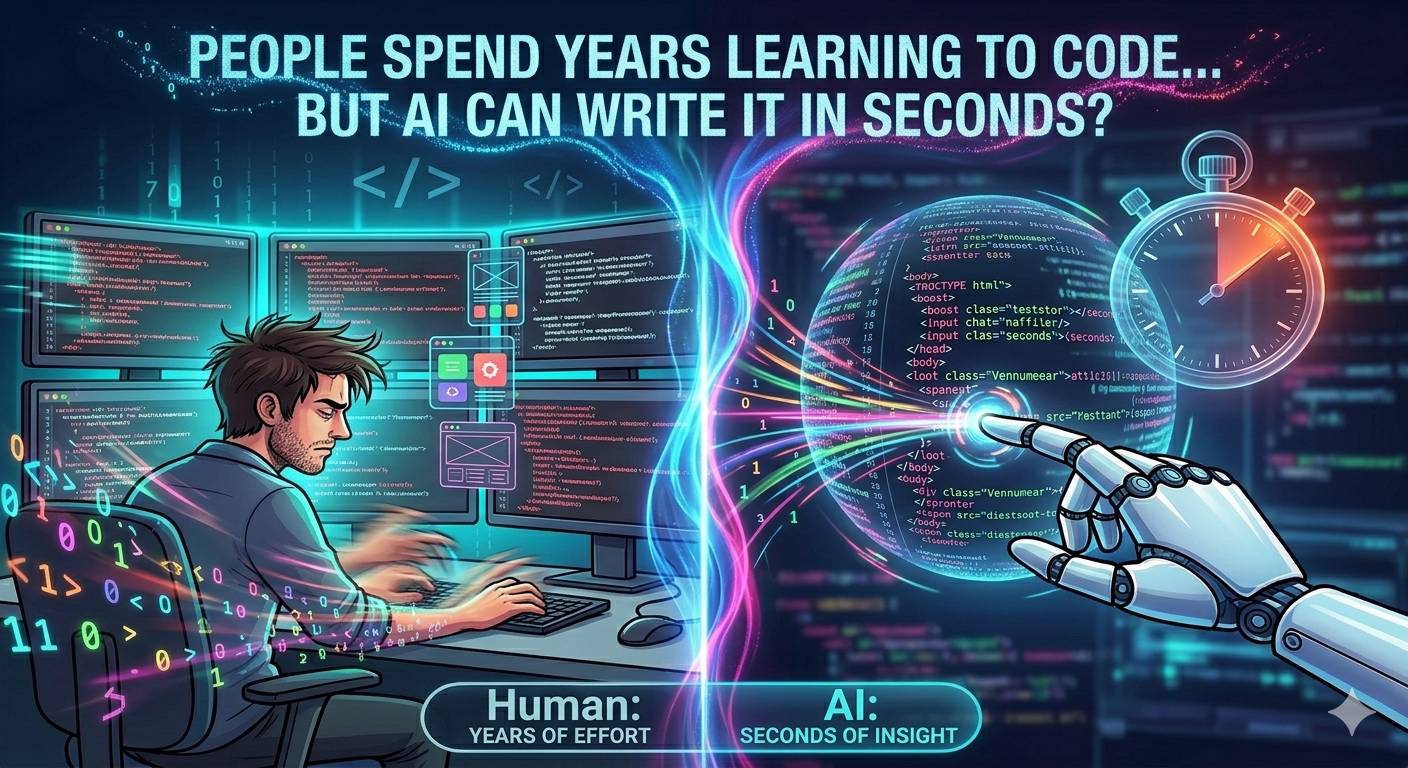
However, the programming industry is now changing rapidly because of artificial intelligence. AI-powered tools such as ChatGPT, Claude AI, GitHub Copilot, and Gemini AI are becoming increasingly popular among developers. These systems can now generate code, explain functions, optimize scripts, and even build simple applications within seconds.
This technological shift has created major discussions across the digital industry. Many people are starting to ask an important question:
If AI can already write code in seconds, what will happen to developers in the future?
Main Discussion
1. The Rise of AI Coding Assistants
Artificial intelligence has become extremely powerful in software development because modern AI systems are trained using massive amounts of programming data, technical documentation, and open-source code.
As a result, AI can now:
- generate code automatically
- explain programming concepts
- fix bugs
- optimize functions
- create website layouts
- assist with debugging
One of the biggest examples is GitHub Copilot, which is specifically designed to help programmers during development. Copilot can suggest entire lines of code and automate repetitive tasks, allowing developers to work more efficiently.
Claude AI is also becoming popular among developers because it can explain complex programming logic in a more natural and detailed way. Many developers use Claude for debugging, planning application structures, and understanding difficult coding concepts.
Meanwhile, tools such as ChatGPT and Gemini AI are increasingly used for:
- generating website code
- creating APIs
- building automation systems
- improving productivity
- learning programming faster
2. AI Is Changing How People Learn Coding
In the past, learning programming often required reading long documentation, searching forums, and watching tutorials for hours. Beginners sometimes struggled to understand even simple coding errors.
Today, AI can instantly:
- explain errors
- generate examples
- simplify coding concepts
- create practice projects
- suggest solutions
This makes programming more accessible for beginners entering the technology industry.
However, there is also a growing concern. Many people are starting to depend too heavily on AI-generated code without fully understanding the logic behind it. This can become dangerous because real software development is not only about writing syntax.
Programming also involves:
- critical thinking
- problem-solving
- scalability
- security
- system architecture
- optimization
Without understanding these fundamentals, developers may struggle when facing real-world software challenges.
3. Will AI Replace Developers?
This is currently one of the biggest discussions in the technology industry.
The answer is not completely simple.
AI is very powerful for repetitive and predictable coding tasks. It can generate templates, automate workflows, and speed up development significantly. However, AI still has limitations.
Artificial intelligence does not truly “understand” software the same way humans do. AI predicts patterns from existing data, but it can still generate:
- insecure code
- incorrect logic
- inefficient structures
- outdated solutions
Human developers are still needed to:
- design systems
- understand business needs
- make strategic decisions
- create user experiences
- solve complex problems
Instead of completely replacing developers, AI is more likely to change how developers work.
4. The Future of Programming in the AI Era
Modern web development is becoming increasingly advanced. Websites today are no longer simple static pages. Many platforms now use:
- cloud infrastructure
- APIs
- AI integration
- databases
- automation systems
- analytics
- responsive frameworks
Because of this, developers are expected to adapt continuously.
The future of programming may no longer depend entirely on who can write syntax the fastest. Instead, developers who can:
- adapt to new technologies
- work with AI tools
- solve complex problems
- think creatively
- understand digital ecosystems
will likely become more valuable in the future.
This is why many companies now prefer developers who can collaborate with artificial intelligence rather than compete against it.
5. AI as a Partner, Not Just a Tool
The rise of AI coding assistants represents one of the biggest transformations in modern technology. AI is helping developers work faster and more efficiently, but human creativity and strategic thinking remain highly important.
In many ways, AI may become a “digital partner” for developers rather than a full replacement.
Developers who understand how to use AI effectively may gain major advantages in:
- productivity
- innovation
- automation
- software development
- digital business
The relationship between developers and AI will likely continue evolving as technology becomes more advanced in the future.
Conclusion
Artificial intelligence is transforming the world of programming faster than many people expected. AI tools such as ChatGPT, Claude AI, GitHub Copilot, and Gemini AI can now generate code, fix errors, and assist developers within seconds.
This technological shift is changing how people learn coding, build software, and work in the digital industry. However, programming is not only about writing syntax. It also involves creativity, logic, strategy, and problem-solving.
AI may automate many coding tasks, but human developers still play a critical role in building meaningful digital systems and innovative technologies.
The future of programming may not be about humans versus artificial intelligence. Instead, it may become a collaboration where developers and AI work together to shape the next generation of digital innovation.